Estimated Revenue Growth
Total Inbound Calls
Qualified Admissions Calls
Pre-Admits Scheduled
What began as the Central Valley’s first Partial Hospitalization Program dedicated entirely to teen mental health has grown into something much bigger — a multi-location provider offering a full continuum of care, from residential inpatient treatment to Intensive Outpatient Programs, all built exclusively around children and teens. Every level of care they offer is built exclusively for children and teens. The challenge was making sure the website communicated that depth and specialization clearly enough to earn the trust of families in one of the hardest moments of their lives.
Ascend Behavioral Health’s website arrived with strong bones — a professional design, Joint Commission accreditation prominently displayed, and a brand that immediately communicated credibility. What it needed was a sharper user journey. Visitors landing on the site, often families navigating a difficult and emotional moment, weren’t being guided clearly enough toward the information that would move them to act. CTAs were underutilized, program pages lacked the specificity users needed to self-qualify, and the human element — the staff and facility behind the care — wasn’t showing up consistently across the site. Create Flo was brought in to close those gaps and build a site experience that matched Ascend’s clinical excellence.
Families researching behavioral health care for a child or teenager are making one of the most emotionally charged decisions of their lives. The website has to do more than inform — it has to reassure. Every change we made was designed to reduce friction, build trust faster, and make it easier for a family to say yes.
We conducted a full heuristic evaluation of the Ascend website alongside its sister brands, mapping every point in the user journey where visitors were losing momentum, missing information, or encountering barriers to conversion.
We restructured program and modality pages to create logical cross-links between conditions treated and therapies offered — so a parent researching a specific challenge could move naturally through the site and find Ascend’s answer to it, without dead ends.
We addressed page speed, mobile performance, and crawlability issues to ensure the site was as strong technically as it was visually — protecting rankings and keeping load times from becoming a reason to leave.
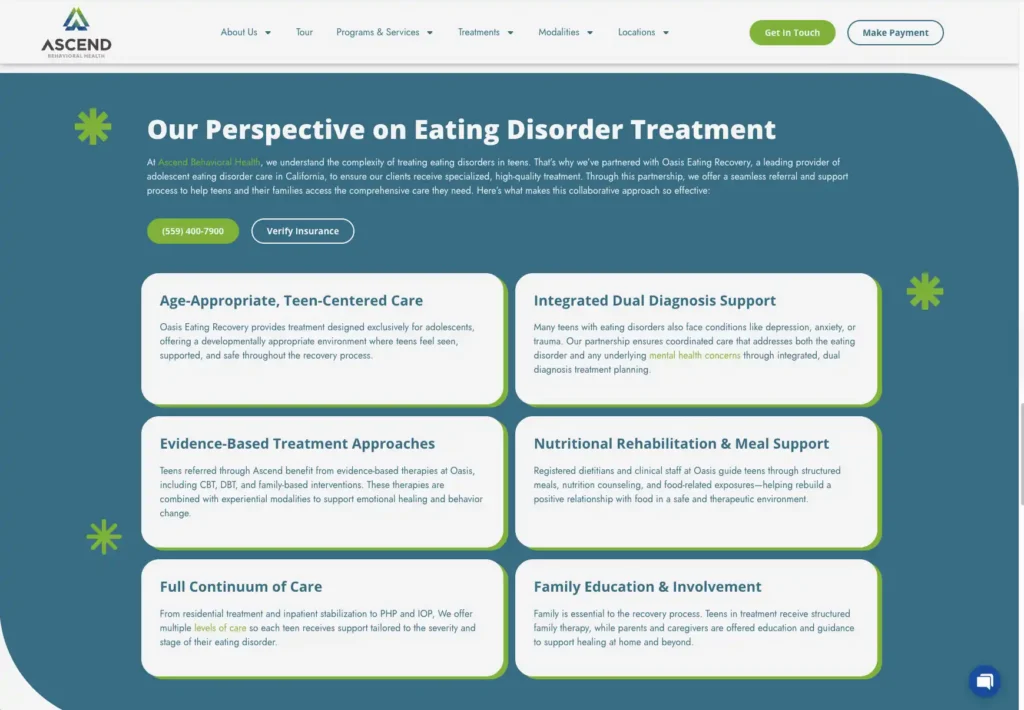
Program pages were rewritten to lead with the conditions and age groups each program addresses. Stronger, more specific calls to action were placed at key decision points throughout the site, and insurance verification prompts were made more visible and accessible across desktop and mobile.
The improvements to Ascend’s website created a clearer, more confident user journey — one that meets families where they are, answers the questions they’re actually asking, and moves them toward contact without friction.
Ascend started as the first teen mental health PHP in the region and has grown into something even more significant — a full continuum of care built exclusively around children and teens. That specialization is its greatest SEO asset. The families who need Ascend are searching for exactly what Ascend provides across every level of care. Our job was to make sure the site showed up for those searches and converted the traffic once it arrived.
We identified the search terms families use when looking for behavioral health care for a child or teenager at every level of need — from residential placement to outpatient step-down — and built a content strategy around capturing them at every stage of the decision journey.
Every program and service page was updated with targeted headers, metadata, and body content reflecting Ascend’s specialties, with calls to action designed to move visitors from research to inquiry.
We resolved crawl issues, improved page speed, and ensured full mobile optimization so the site performs for search engines as well as it does for users arriving in a moment of need.
A structured internal linking strategy was built between condition pages, therapy pages, and program pages — guiding users deeper into the site and giving search engines a clear map of Ascend’s content architecture.
Ascend’s Google Business Profile and local presence were optimized to maximize visibility in Fresno and surrounding areas, ensuring the site captures families searching for care close to home.
New program and condition-specific content was developed across Ascend’s full continuum — residential, PHP, and IOP — to fill gaps in topical coverage and establish Ascend as the authoritative resource for families seeking youth and adolescent behavioral health care in the region.
Ascend’s websites were already visually calming and professionally designed — a natural reflection of their mission of support and healing. Our focus was on deepening the user journey so that the design didn’t just look right, but worked harder to convert the families who needed it most.
Every design decision was made to reflect Ascend’s identity as a youth-focused behavioral health provider — warm, trustworthy, and clinical without being cold. Facility photography was integrated throughout to help families visualize the environment and feel confident before they ever pick up the phone.
We mapped the full user journey and identified where families were losing momentum — missing program information, unclear next steps, and CTAs that weren’t visible enough when it mattered most. Each gap was addressed to create a smoother, more reassuring path from first visit to first contact.
Families searching for behavioral health care for a child often do it on their phones, in stressful moments. We ensured every page — including forms, CTAs, and insurance verification prompts — was fully optimized for mobile so nothing stood in the way of someone reaching out.
Design and search strategy were built together, not bolted on separately. Program pages were restructured to serve both users and search engines — with clear condition overviews, targeted keywords, and internal links that guide visitors deeper into the site while signaling topical authority to Google.
The existing sites had strong visual foundations but left users to find their own way. After our work, every key page — from therapy and modality pages to program overviews — had a clear structure, strategically placed staff sections to build trust, and visible CTAs that made the next step obvious.